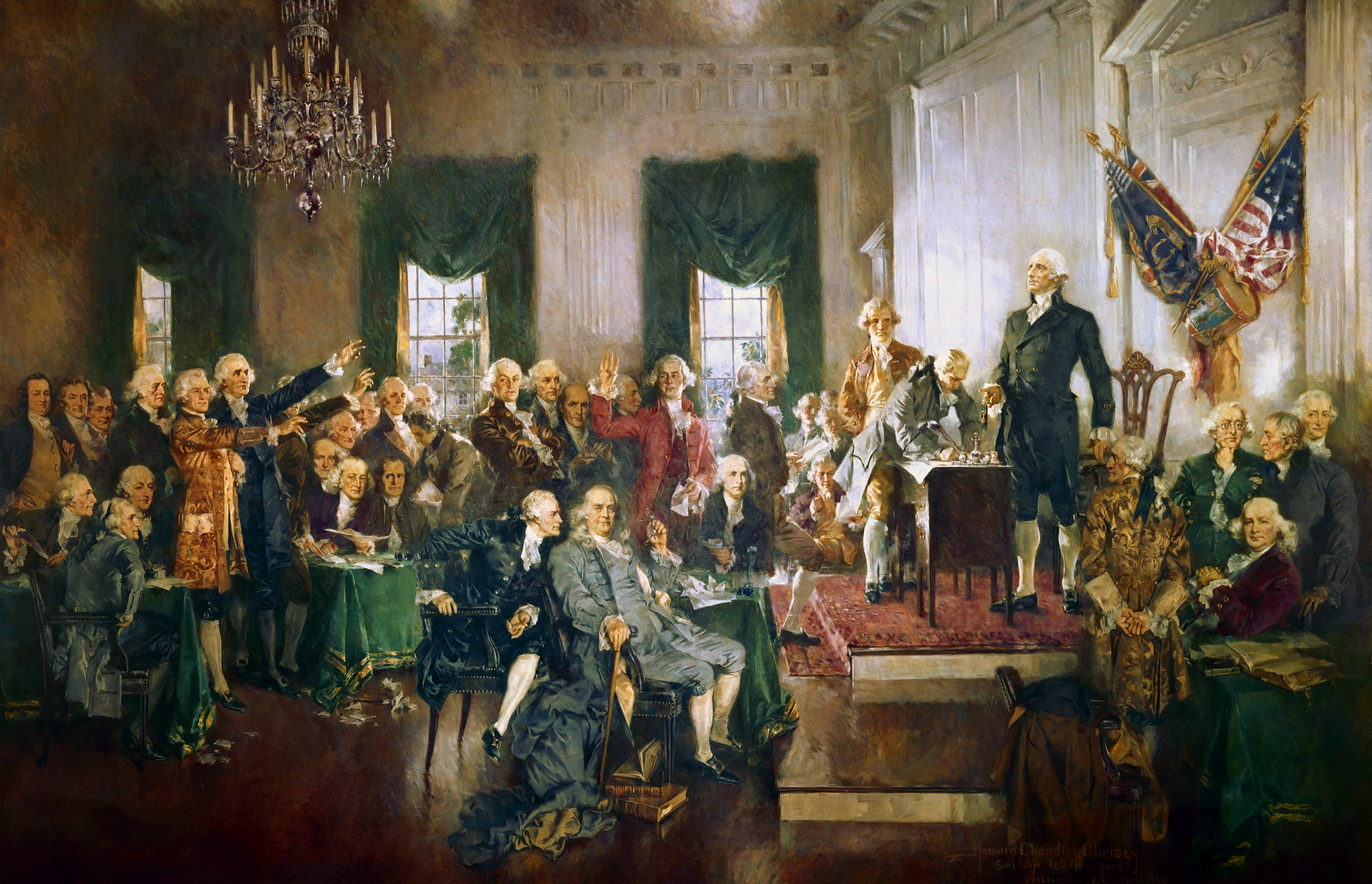
Supplemental Materials for the Constitutional Convention Simulation
Getting Started
The summer of 1787 was one of the most dramatic moments in American history.
A mere four years after securing independence, the United States was collapsing under the weight of its own contradictions. Shays’ Rebellion had exposed the fundamental weakness of the Articles of Confederation. State currencies had become essentially worthless. European powers, particularly Britain and France, viewed the fledgling United States with a mixture of contempt and amusement and exploited individual state trading policies for their own benefit.
Into this crisis stepped some of the most extraordinary figures in American history, collectively referred to as The Founders. Men like George Washington, whose presence alone lent crucial legitimacy to the gathering in Philadelphia and Benjamin Franklin, who, at 81, was actually carried to meetings in a sedan chair but was as mentally sharp as ever, and brought decades of diplomatic experience. And the Virginian James Madison arrived at the Convention with detailed plans and proposals after thorough preparation by reading classical Roman and Greek texts.
This simulation will allow us to step into their shoes and consider: What would we have done in their position? How would we have navigated the competing interests among the states and forged workable compromises? Using the information provided from a variety of sources, each of you will inhabit the role of one of the major delegates who contributed to the outcome of the Constitutional Convention.
Let’s see if we can rise to the challenge facing the delegates in 1787.
★ ★ ★
The Five Core Issues
This activity will proceed in two stages. The first stage will involve the debates and issues that went into designing and creating the constitution. We will focus on 5 major problems that proved challenging to resolve:
Legislative Branch Structure & Representation
Unicameral vs bicameral system debate
Representative numbers and apportionment
Selection method for representatives
Legislative & Executive Branch Powers
Defining specific powers for each branch
Balancing state and federal authority
Checks & Balances
Power distribution among branches of government
Bill of Rights
Necessity for a Bill of Rights
Individual liberties protection
Slavery and the Slave Trade
Economic Implications — International vs. Domestic Slave Trade
Moral Considerations
Reading Assignments
Prior to the Convention
Chapter 1 — Writing a Constitution
Chapter 2 — The Men of Philadelphia
Day 1
Chapter 7 — Representation: By State or Population?
Day 2
Chapter 8 — Local Control vs. National Authority
Chapter 9 — Majority Rule vs. Checks and Balances
Day 3
Chapter 10 — A Bill of Rights
Chapter 11 — Slavery and the Slave Trade
All chapter content is embedded in this site under the appropriate Day tabs and in the Reference section. You can read everything right here.
Convention Schedule
Day 1 — Representation & the Legislative Branch
Presentations: Virginia Plan (Madison/Randolph), New Jersey Plan (Paterson), Great Compromise (Sherman), Three-Fifths Compromise (Wilson)
Debate on representation
Voting on 6 issues related to legislative structure
Day 2 — Powers & Checks and Balances
Presentations: Powers of the Legislative Branch (Madison/Randolph), Powers of the Executive (Hamilton)
Debate on legislative powers, executive powers, and checks & balances
Voting on powers and structure issues
Day 3 — Bill of Rights & Slavery
Presentations: A Bill of Rights (Martin), Slavery and the Slave Trade (Mason)
Debate on both topics
Voting on Bill of Rights and slavery provisions
Ratification
Each delegate represents their state in the ratification process
Position papers on whether to ratify or reject the class’s Constitution
Brief debate and final vote — 9 of 12 states required for adoption
Rules of Order
Basics
Each state delegation gets one vote.
Passage of a motion requires 7 out of 12 states to vote in favor.
The President (George Washington) presides over the convention.
Daily Order of Business
Call to Order
New Business (proposals for the Constitution)
Announcements
Adjournment
Key Motions and Procedures
1. Main Motion
Purpose: To introduce a new piece of business or a proposed provision for the Constitution.
Procedure:
Delegate rises and addresses the President.
The President recognizes the delegate.
Delegate says, “I move that…” and states their proposal.
Another delegate seconds the motion by saying, “Second!”
The President restates the motion and opens debate.
Delegates debate the motion. They must be recognized by the President before speaking.
When debate concludes, any delegate can call for a vote.
The President announces the result: “The motion passes (or fails).”
2. Motion to Amend
Purpose: To change or modify a pending motion.
While a main motion is being debated, a delegate may rise and say, “I move to amend the motion by…” and propose their change.
Another delegate seconds the amendment.
Delegates debate and vote on the amendment.
If the amendment passes, the main motion is now amended. If it fails, the main motion remains unchanged.
Debate resumes on the main motion.
3. Motion to Caucus
Purpose: To allow delegates to informally discuss the motion or issue with others before proceeding.
A delegate rises and says, “I move to caucus for [time, e.g., 5 minutes].”
Another delegate seconds the motion.
The President calls for an immediate vote without debate.
If the motion passes, delegates may leave their seats and discuss informally for the specified time.
At the end of the caucus, the President calls the session back to order.
4. Motion to Table
Purpose: To postpone discussion of a motion until later.
A delegate says, “I move to table the motion.”
Another delegate seconds.
No debate is allowed.
The President calls for an immediate vote.
If the motion passes, the topic is set aside and may be revisited later.
5. Motion to Call the Question
Purpose: To end debate and proceed immediately to a vote on the motion.
A delegate rises and says, “I move to call the question.”
Another delegate seconds.
The President calls for an immediate vote.
If two-thirds of delegates vote in favor, debate ends, and a vote on the motion occurs immediately.
6. Motion to Adjourn
Purpose: To end the session.
A delegate moves to adjourn.
Another delegate seconds.
No debate is allowed.
The President calls for an immediate vote.
Points of Order and Privilege
Point of Order: To correct a procedural error. A delegate rises and says, “Point of order.” The President recognizes the delegate, who explains the issue. The President rules on the point.
Point of Personal Privilege: To address a matter of personal urgency. A delegate rises and says, “Point of personal privilege.” The President grants the request without a vote.
General Reminders
Delegates must be recognized by the President before speaking.
Delegates should address each other respectfully, through the President.
The President ensures order and keeps the debate on track.
Grading & Assignments
This is a 200 point project (160 pts writing, 40 points participation) in which each of you will produce 4 documents:
Position Paper — assigned to your specific delegate (300–500 words). If your delegate does not write a position paper, you must complete a 500-word minimum explanation for your votes for all 3 days. Everyone will write a minimum of 2 voting explanations.
Voting Explanations — for the days of the Convention you did not present. 500–750 words total per day.
Ratification Reflection — due at the conclusion of the Convention.
Final Reflection — responding to the three reflection questions.
Participation Rubric (40 pts)
Category
Points
Criteria
Preparation
10
Thoroughly researched delegate’s views; prepared notes and talking points; demonstrated understanding of key issues
Debate
15
Actively participated; made arguments consistent with delegate’s views; responded thoughtfully to others; used parliamentary procedure correctly
Collaboration
10
Worked effectively to find compromises; showed respect for other delegates; contributed to productive atmosphere
Role-Playing
5
Consistently stayed in character; used period-appropriate language and rhetoric
Chapter 1: Writing a Constitution
Digital History materials adapted from Thomas Ladenburg, Digital History
“We hold these truths to be self-evident: that all men are created equal, that they are endowed by their Creator with certain unalienable Rights, that among these are Life, Liberty and the pursuit of Happiness. … That to secure these rights, governments are instituted men, deriving their just powers from the consent of the governed.”
So wrote Thomas Jefferson in the Declaration of Independence, the renowned document penned and published in 1776 that officially proclaimed the independence of the colonies from Great Britain. These time-honored words reflect much about the colonists’ continuing struggle with King George III and Parliament. In the eyes of Jefferson and many others, the British government had failed to guarantee the colonists the rights they deserved. In declaring independence, Jefferson and his compatriots set out to free the colonies from oppressive overseas rule and establish governments that fulfilled the desires of the people and guaranteed them necessary rights. To that end, Jefferson proceeded to insist in the Declaration that each colony have the power to establish an independent government. “[A]s free and independent states,” he wrote, “[the former colonies] have full power to do all acts and things which independent states may of right do.”
Having overthrown one government, the new nation immediately began creating fourteen new governments. As each colony assumed statehood, it appointed committees to draw up a state constitution in order to define and establish the duties, powers, and organization of the government. In the meantime, Congress appointed a committee to write a national constitution that would govern all these “free and independent states.”
The Articles of Confederation
Furthermore, the Articles of Confederation allowed for a different relationship between state governments and the national government than it does today. The powers granted Congress were severely limited — it had the power to coin money, make treaties, raise armies, and wage war, but it lacked the authority to collect taxes, impose tariffs, suppress rebellions, draft soldiers, or to regulate trade between the states and with foreign countries. The states had many of the powers the Articles had denied them: coining money, taxing imports (even from other states), raising armies, and enforcing treaties. Congress’s reliance on states for law enforcement made the central government weak and the state governments strong. If Congress lacked money, for instance, it would ask the states for the necessary funds and the states could decide whether to supply the national government with the money it needed.
As time wore on, the government created by the Articles of Confederation proved less and less effective. In 1786, a rebellion led by Daniel Shays of Massachusetts demonstrated the weaknesses of the Confederation. Farmers, who had suffered monetary losses in the years following the Revolution, wanted their debts canceled and demanded that the state legislature print paper money. When the legislature refused, the rebels attacked the federal arsenal in Springfield. The rebellion was suppressed only after Boston merchants raised enough money to put together an army to oppose Shays.
Many American leaders looked to the incident in Massachusetts as proof that America needed a stronger central government — a government that could put down rebellions, solve financial problems, and resist the demand for paper money. Having witnessed the U.S. government’s problems in winning the Revolution, collecting taxes, regulating trade, and conducting foreign policy, other colonists shared this lack of confidence in the government of the Confederation. They called for a new constitution to remedy the problems that plagued the nation.
Alexander Hamilton, James Madison, and George Washington led the movement for a new constitution. In February of 1787, Congress called for a convention to meet in Philadelphia in order to “revise” the Articles of Confederation. Ignoring their limited instructions, fifty-five delegates, representing twelve different states, decided that the U.S. needed a completely different plan of government. They scrapped the Articles and proceeded to take on the daunting task of writing what became the constitution that has governed this nation since its ratification in 1788.
Issues before the Convention
The men who gathered at the Convention considered an endless number of issues as they pieced together the new constitution. Five of the major problems they faced included:
Representation by state or by population: Large and populous states, including Pennsylvania, Massachusetts, and Virginia, wanted each state to have votes in Congress in proportion to their population. Thus, Virginia, with 821,000 inhabitants, would have 16 votes, while Delaware, with 59,000 people, would have but one vote. Sparsely populated states, such as Delaware, New Jersey, and Georgia, insisted that each state have one vote, as they had under the Articles. Some of the middle-sized states, like Connecticut, were prepared to offer a compromise — a House of Representatives based on population and a Senate based upon equal votes for all states.
Local control (states’ rights) vs. national authority: All the delegates wanted to give the national government more power than it had under the Articles of Confederation, but the question remained: how much more? Extremists like Alexander Hamilton of New York and Gouverneur Morris of Pennsylvania wanted to abolish state governments completely. States’ rights advocates such as John Lansing of New York and Luther Martin of Maryland, on the other hand, felt that “the General Government was meant merely to support the State governments.” The Convention worked hard to find a solution somewhere between these opposing positions and had a difficult time arriving at an acceptable solution.
Democracy vs. checks and balances: Some of the founding fathers, including Morris and John Dickinson of Delaware, had little faith in the general public who, they felt, “can be little trusted with the public interest.” They wished to limit the common people’s power in the government and suggested four ways of accomplishing this goal: (1) restricting the right to vote to white males with property, (2) not allowing the voters to elect the president, senators or judges, and (3) guaranteeing the chief executive immunity from impeachment. The democratic faction, headed by James Wilson and Benjamin Franklin of Pennsylvania, Hugh Williamson of North Carolina, and Luther Martin of Maryland, tended to favor short terms for elected officials, universal manhood suffrage, direct elections of senators and the president, and giving congress power to impeach the chief executive. Most delegates stood somewhere in between these extremes, and they took it upon themselves to engineer a series of compromises on the issue.
The Bill of Rights: Several delegates, including Martin, Elbridge Gerry of Massachusetts and George Mason of Virginia, wanted a bill of rights that would limit the powers of the government by protecting the rights of the people. Others, such as Hamilton, Wilson, and Nathaniel Gorham of Massachusetts, opposed such a bill. Charles Pinckley of South Carolina had concrete suggestions for a bill protecting certain rights. The convention had to decide whether it wanted or needed a bill of rights, and what rights should be protected.
Slavery and the slave trade: The question of slavery — and, in particular, the slave trade — stood out as one of the most controversial issues at the convention. Several slave owners (including Martin, Mason, and James Madison of Virginia) wanted to end the slave trade. Some delegates favored outright abolition of slavery. Pinckley and Edmund Rutledge of South Carolina voiced strong objections to anti-slavery sentiment, however, and threatened to walk out of the Convention if the slave trade were abolished. Many northern delegates feared that this issue might split the Union, paid close attention to the opinions of pro-slavery southerners.
Suggested Student Exercises
Briefly restate the five major issues which were raised in seeking to revise the Articles of Confederation.
Read at least eight of the biographies in Chapter 2 to help you decide whose views you would like to represent in a simulated reenactment of the Constitutional Convention.
Chapter 2: The Men of Philadelphia
Digital History materials adapted from Thomas Ladenburg, Digital History
Altogether, fifty-five men, representing twelve of the thirteen states came to Philadelphia to revise the Articles of Confederation. Only Rhode Island refused to send any delegates. Those who ventured to the Convention were a talented group of men, perhaps the most talented ever to assemble for the purpose of writing a constitution. They were well educated and experienced in government; they were men of affairs who had served their country in colonial legislatures, the Continental Congress, and/or the armed service. They included slave owners from the south, merchants from the north, a large company of lawyers, and various men of business. Many of them knew from first-hand experience the frustrations of running a government with no money and no power.
The wealth and social status of the men who came to Philadelphia stood out perhaps as much as their intellect and experience. As lawyers, slave owners, and shippers, they represented an elite group of Americans that differed significantly from the rest of the population which consisted of farmers, indentured servants, mechanics, day laborers and slaves. While few Americans owned government bonds, a full 40 of the 55 delegates had invested or would invest in such securities. Furthermore, fourteen had speculated in western lands, twenty-four had lent money at interest; eleven had invested in manufacturing and shipping; and fifteen owned slaves. None of the delegates were African-Americans, none were women, and only one was a small farmer. Clearly, the 55 delegates who convened in Philadelphia were not typical Americans.
While the Founders’ numbers were drawn from the ranks of uniquely qualified individuals, some famous Americans were not at the convention. Those notables not in attendance included: Thomas Jefferson, author of the Declaration of Independence, who was serving his country as ambassador to France; fellow Virginian, Patrick Henry, who claimed he “smelled a rat” and decided to skip the proceedings; and Sam Adams, John Hancock, and Thomas Paine, who among the leaders of the Revolution were branded as radicals.
The Delegates
Explore each delegate's biography and positions on the five core issues. Click any card to view details, or select 2–3 delegates to compare their positions side by side.
The Twelve Convention States
Hover over a state to see population data from the 1787 census. Color indicates state size category; border indicates region.
Large State Medium State Small State| Northern Southern
Size Category:
Region:
Total Population:
Enslaved Population:
% Enslaved:
Filter:
Select 2–3 delegates to compare
Abraham Baldwin
Georgia
Small StateSouth
Alexander Hamilton
New York
Large StateNorth
Benjamin Franklin
Pennsylvania
Large StateNorth
Charles C. Pinckney
South Carolina
Medium StateSouth
Edmund Randolph
Virginia
Large StateSouth
Elbridge Gerry
Massachusetts
Large StateNorth
Gouverneur Morris
Pennsylvania
Large StateNorth
Hugh Williamson
North Carolina
Medium StateSouth
James Madison
Virginia
Large StateSouth
James Wilson
Pennsylvania
Large StateNorth
John Dickinson
Delaware
Small StateSouth
John Langdon
New Hampshire
Small StateNorth
Luther Martin
Maryland
Medium StateSouth
Roger Sherman
Connecticut
Medium StateNorth
William Paterson
New Jersey
Small StateNorth
Delegate Comparison
Day 1 — Representation & the Legislative Branch
“How should the states be represented in the new national legislature? Should each state have equal voice, or should representation reflect population? And if population determines representation — who counts?”
Consider These Angles
Why did large states favor proportional representation? What would they gain — and what would small states lose?
Why did small states insist on equal representation? Was their fear of domination by large states reasonable?
What was Roger Sherman’s compromise, and why did it eventually succeed where the Virginia and New Jersey Plans could not?
The Three-Fifths Compromise: Why did Southern states want slaves counted for representation but not for taxation? Why did Northern states object?
How does the method of selecting representatives (elected by the people vs. chosen by state legislatures) affect the balance of power?
Key Context: The Virginia Plan vs. The New Jersey Plan
The Virginia Plan
Introduced by Edmund Randolph (but largely drafted by James Madison), the Virginia Plan proposed a bicameral legislature with representation in both houses based on population. This would give large states like Virginia, Pennsylvania, and Massachusetts dominant influence. The plan also called for a national executive chosen by the legislature and a national judiciary.
The New Jersey Plan
William Paterson countered with the New Jersey Plan, which preserved the structure of the Articles of Confederation: a unicameral legislature where each state had one equal vote, regardless of population. Small states saw this as essential to prevent domination by their larger neighbors.
Why These Plans Framed the Central Conflict
The Virginia and New Jersey Plans represented fundamentally different visions of the Union. Was the national government a compact among equal sovereign states, or a government of the people in which larger populations deserved greater representation? This question nearly destroyed the Convention before it began.
The Great Compromise
Roger Sherman of Connecticut proposed the solution that saved the Convention: a bicameral legislature in which the House of Representatives would be apportioned by population (satisfying the large states) and the Senate would give each state equal representation with two votes (protecting the small states). This “Connecticut Compromise” broke the deadlock and became the foundation of the legislative branch.
Day 1 Presentations
The following delegates will give presentations on Day 1:
James Madison / Edmund Randolph — The Virginia Plan
William Paterson — The New Jersey Plan
Roger Sherman — The Great Compromise
James Wilson — The Three-Fifths Compromise
Voting Issues for Day 1
Unicameral or Bicameral Legislative Branch? (Yea or Nay)
Delegates determined by Population or Equal Representation?
How are delegates chosen to the National Legislature?
Slaves counted when determining population for representation? (Yea or Nay)
Number of delegates per what aspect of population? (1 per 50k, 40k, or 30k)
Slaves counted when determining amount owed by states to the Federal government? (Yea or Nay)
Background Reading: Chapter 7 — Representation: By State or by Population?
Chapter 7: Representation: By State or by Population?
Digital History materials adapted from Thomas Ladenburg, Digital History
One of the major issues delegates to the Convention had to resolve was how many votes each state should have. Under the Articles of Confederation, each state had one vote, regardless of size. The states were considered equals. At the Convention, each state had one vote, even though some delegations consisted of three or four people and others only one or two.
Some delegates, particularly those from larger states, thought it unfair for each state to have the same number of votes. They thought the states’ votes should be divided according to population, with the more populous states having more votes than the less populous. That way, the people within the states would be equal.
Delegates from smaller states opposed this plan, believing that the states had entered the Articles as equals and should not be deprived of this equality. The issue was important because it would affect the number of delegates each state would send to Congress and therefore the power of each state in the new government.
Three Important Positions Considered at the Convention
That each state in Congress (and at the Convention) has representation in proportion to population. Madison, King, Wilson, Morris, and Randolph strongly supported this position; they had some backing from Hamilton, Pinckley, and Washington.
That each state in Congress has one vote. Brearly, Dickinson, Read, Paterson, and Martin strongly supported this position; they had some backing from Pierce.
That each state in Congress has two votes in a senate and votes in a second branch of the legislature in proportion to their population. Franklin, Sherman, Ellsworth, and Gorham strongly supported this position; they had some backing from Gerry, Mason, Rutledge, and Williamson.
Suggested Student Exercises
Restate the issue before the convention, using your own words.
Take notes on the reading covering the convention debate. Make sure that you have understood each of the speeches. You should be able to figure out: (a) what the person is saying, (b) how he is supporting his point, (c) whether or not you agree with him and why.
If your delegate has a position on the issues in this debate, summarize this position in not fewer than 20 words. Then write a 100–150-word statement giving several strong arguments supporting his case. You should use arguments that delegates with similar views made in their speeches, and you should make references to things that have been discussed in class before; or
If it is your turn to make a speech, write a really strong speech (of 200–250 words), showing why you think the issue is important and why people should agree with you. Use dramatic flourishes, humor, and analogies. You should borrow arguments from other delegates and make reference to things discussed in class. Give the kind of speech you’d enjoy hearing. Practice the speech at home; or
If your delegate does not have a position on this issue, come to class ready to be convinced or to make a deal.
The Convention Debate: Representation (Chapter 7)
Mr. Madison of Virginia
The equality of suffrage established by the Articles of Confederation ought not to prevail in the national Legislature, and an equal ratio of representation based on population ought to be substituted.
Mr. Read of Delaware
I move that the whole motion on the question of representation be postponed. May I take this opportunity to remind the convention that the delegates from Delaware received explicit orders from the state not to allow any changes in the method of representation? If such a change is made and agreed upon, Delaware may have to leave the Convention.
Mr. Madison of Virginia
Whatever reason there may have been for equal votes by states under the Articles of Confederation, it must change with the creation of a national government. Under the Articles, the Congress depended completely upon the states to carry out its laws. With the new government we intend to create, however, it would not be fair for the small states to have as much say as the large ones.
Mr. Morris of Pennsylvania
It would be of great concern to me if Delaware would withdraw her valuable assistance in writing the Constitution. The question of representation is too important to be buried, however. We must decide this question.
Mr. Brearly of New Jersey
I am sorry that anyone would want to change the arrangement we have under the Articles of Confederation. This issue had already been discussed for far too long when we wrote the Articles. We decided at the time that each state is equal and independent — and that equal states should have equal votes. Let us be wise enough not to change a decision made after much consideration. At first glance it may seem fair to give votes to states on the basis of their population; but stop to think about this for a minute. Would it be fair to give Virginia 16 votes and Georgia only one? Would it be fair to give three large states more votes than the rest of the country together?
Mr. King of Massachusetts
I am really astonished to hear you. You are ready to sack our great plan for proportional representation because of the single folly of these phantoms you call states? A government based on your principles of states’ rights would be as short-lived as it is unjust.
Mr. Paterson of New Jersey
I quite agree with my colleague from New Jersey. Proportionate representation would ruin the smaller states — it would make them powerless. Furthermore, this idea would go beyond the powers given to us as convention delegates. May I remind those who would destroy the Confederacy that we came here to amend it, not to write a new constitution. Let us stick with the plan of giving each state one vote, as in the Articles. We must follow what the people want, and the people want a confederation of states, not a single nation.
Mr. King of Massachusetts
I don’t know what you are talking about. You are talking about these states as if they were separate bits of real estate. They are not self-governing. They do not possess the attributes of self-government. They are dumb, for they can’t speak to foreign countries; they are deaf, for they can’t hear and receive ambassadors from foreign countries. They cannot defend themselves in war. They only exist because they are part of a Union of States.
Mr. Martin of Maryland
I most heartily disagree. When we separated from England, we became thirteen independent states, in a state of nature toward each other. We entered into that confederation on a footing of equality. I will never give in to a plan that would put ten states at the mercy of Virginia, Massachusetts, and Pennsylvania.
Mr. Wilson of Pennsylvania
There is not much hope left for this confederacy. We aren’t even able to collect our taxes. When it finally falls apart, some of the states are going to have to unite for their own safety and we hope New Jersey will join us. If she decides not to, good luck to her, but join together we will, with or without New Jersey.
Mr. Paterson of New Jersey
There is no more reason that an individual state contributing much should have more votes than a small state contributing little, than that a rich citizen should have more votes than a poor citizen. If you make the mistake of giving the large states an influence in proportion to their size, what will be the results? Their ambitions will be increased and the small states will have everything to fear.
Mr. Wilson of Pennsylvania
Some people don’t really believe in equality. They don’t understand that governments are based on the consent of the people. The people are supreme. They are worth more than an artificial set of boundaries called New Jersey or Pennsylvania. Equal numbers of people should have equal representation and different numbers of people should have different representation.
Mr. Dickinson of Delaware
We would sooner admit to a foreign country than submit to be deprived of an equality of suffrage in both branches of the legislature, and be thrown under the domination of the large states.
Mr. Wilson of Pennsylvania
The honorable delegate tells us from Delaware that each state is sovereign because it rules over its own people. But all states are composed of people who rule over themselves. These sovereign people are equals. Equal numbers of people must be entitled to equal numbers of delegates.
Mr. Paterson of New Jersey
I will oppose any plan for proportionate representation. I will oppose it here; I will oppose it when I get back to New Jersey; I will oppose it as long as there is breath in my body to fight against the scheme.
Mr. Wilson of Pennsylvania
Let us not hear any more talk of refusing to go along with the Convention. Each state must give up some of its rights in order to create a true national government resting on the one foundation that government must rest upon: equal people with equal representation.
Dr. Franklin of Pennsylvania
The diversity of opinions turns on two points. If a proportional representation takes place, the small states believe that their liberties will be in danger. If an equality of votes is to be put in its place, the large states say their money will be in danger. Gentlemen, we seem to have reached a stalemate, but I have a solution to our problem. When a broad table is to be made, and the edges do not fit, the carpenter takes a little from both sides and makes a good joint. In like manner here both sides must part with some of their demands, in order that they may join in some accommodating proposition.
Mr. Sherman of Connecticut
Mr. Franklin, you are quite right. It seems logical that some sort of compromise must be worked out. Why not have a legislature consisting of two houses of Congress? In the first branch, the vote can be given to states according to their population, and in the second branch, each state can have the same number of votes. This way the small states would be able to protect themselves from the few large states that otherwise would rule the rest.
Mr. Rutledge of South Carolina
The proportion of votes in the first branch should be based on the monetary contribution of each state to the country as a whole. The justice of this rule cannot be denied. We all know that money is power, and the states should have a say in government in proportion to their wealth.
Key Data: State Populations
State populations at the time of the Convention. Number in legislature based on 1 representative for every 50,000 people.
State
Total Population
Slave Population
Number in Legislature
Virginia
821,000
292,000
16
Massachusetts
475,000
Negligible
9
Pennsylvania
434,000
3,700
8
North Carolina
429,000
100,000
8
New York
340,000
21,000
6
Maryland
319,000
103,000
6
South Carolina
249,000
107,000
5
Connecticut
231,000
2,670
5
New Jersey
184,000
11,420
3
Georgia
82,000
29,000
2
Three Key Positions at the Convention
Proportional Representation
Madison, King, Wilson, Morris, and Randolph strongly supported this position; they had some backing from Hamilton, Pinckney, and Washington.
Equal State Representation (One Vote per State)
Brearly, Dickinson, Read, Paterson, and Martin strongly supported this position; they had some backing from Pierce.
The Great Compromise (Bicameral: Population + Equal)
Franklin, Sherman, Ellsworth, and Gorham strongly supported this position; they had some backing from Gerry, Mason, Rutledge, and Williamson.
Position Paper & Voting Explanation
Position Papers & Voting Explanations
Delegates who present today write their position papers (300–500 words), due on the day of presentation.
All other delegates must write a voting explanation (500–750 words total) explaining their votes on each issue. Due the following class.
Complete readings for Chapter 1 and Chapter 2 are available in their own tabs.
Day 2 — Powers & Checks and Balances
“How much power should the national government have? Should it be able to override state laws? And how should power be divided among the branches to prevent tyranny — while still creating a government that actually works?”
Consider These Angles
Hamilton wanted to abolish state governments entirely. Martin wanted to barely change the Articles. Where is the right balance, and why?
Madison argued for a national veto on state laws. Lansing called this worse than British tyranny. Who has the stronger case?
Should the President be elected by the people, by electors, or by the legislature? What are the dangers of each method?
Hamilton admired the British monarchy and wanted a president who serves for life. Was this a serious proposal or a negotiating tactic?
What did the Founders fear more — tyranny by the government, or tyranny by the people? How did this shape their design?
Key Context: Legislative and Executive Power
The Spectrum of Views on National Power
The delegates ranged from extreme nationalists (Hamilton, who wanted to abolish state governments and create an “elective monarch”) to fierce defenders of state sovereignty (Martin, who accused the Convention of trying to “enslave the common man”). Most delegates fell somewhere in between, agreeing the national government needed more power but disagreeing on how much.
The Veto Power Debate
Madison wanted the national government to have veto power over all state laws — modeled on the British Crown’s authority over colonial legislation. Opponents argued this would be worse than the tyranny they had just overthrown. The eventual compromise created the Supremacy Clause instead.
The Executive Question
Should the executive be a single person or a council? How should they be chosen? Hamilton wanted a single executive serving for life; Franklin wanted a plural executive with no salary. The debates over presidential selection, term length, and powers consumed enormous amounts of convention time.
Checks and Balances as Compromise
Rather than choosing between strong national power and strong state power, the Convention developed a system of checks and balances — giving each branch of government tools to limit the others. This framework became the defining architectural feature of the Constitution.
Day 2 Presentations
James Madison / Edmund Randolph — Powers of the Legislative Branch
Alexander Hamilton — Powers of the Executive
Checks and Balances discussion will be integrated with both presentations
Voting Issues for Day 2
Scope of national legislative power
Presidential selection method
Presidential term length and re-eligibility
Veto power structure
State law override mechanism
Note to instructor: Modify these voting issues based on how the debate unfolds in your class.
Background Reading: Chapter 8 — Local Control vs. National Authority
Chapter 8: Local Control vs. National Authority
Digital History materials adapted from Thomas Ladenburg, Digital History
The Founders came to Philadelphia in order to expand on the powers granted the national government under the Articles of Confederation. They generally agreed that the nation could not survive unless the national government had the power to assess and collect taxes, stop the states from issuing money, stop interstate tariffs, and enforce treaties. Many of the Founders did not wish to stop with these revisions. They sought nearly unlimited powers for the national government, including the power to veto all state laws contrary to the Constitution. Others jealously guarded the rights and powers of the states and feared that the revitalized national government might crush the states which, they felt, were far more responsive to the will of their inhabitants than a large and far-away government could be.
Three Important Positions Considered at the Convention
That the national government should have the power to make laws in all cases in which the harmony of the United States may be interrupted and to veto all laws passed by individual states that contradict or violate the Constitution. Hamilton, King, Morris, Franklin, Dickinson, Madison, and Washington strongly supported this position; they were supported by Gorham, Paterson, Williamson, and Wilson.
That the national government should make laws binding on the people of the United States only in cases that clearly concern the common interests of the country, but otherwise should not interfere with the governments of the individual states. Martin, Lansing, Mason, and Gerry strongly supported this position; they had some backing from Randolph.
A third position that would require a compromise between the two aforementioned possibilities. Brearly, Ellsworth, and Sherman would probably play a leading role in this attempt to work out a third position.
Suggested Student Exercises
Restate the issue before the convention, using your own words.
Take notes on the reading covering the convention debate. Make sure that you have understood each of the speeches. You should be able to figure out: (a) what the person is saying, (b) how he is supporting his point, (c) whether or not you agree with him and why.
If your delegate has a position on the issues in this debate, summarize this position in not fewer than 20 words. Then write a 100–150-word statement giving several strong arguments supporting his case. You should use arguments that delegates with similar views made in their speeches, and you should make references to things that have been discussed in class before; or
If it is your turn to make a speech, write a really strong speech (of 200–250 words), showing why you think the issue is important and why people should agree with you. Use dramatic flourishes, humor, and analogies. You should borrow arguments from other delegates and make reference to things discussed in class. Give the kind of speech you’d enjoy hearing. Practice the speech at home; or
If your delegate does not have a position on this issue, come to class ready to be convinced or to make a deal.
The Convention Debate: National Authority (Chapter 8)
Colonel Hamilton of New York
Two equal sovereign states cannot exist within the same boundaries. You cannot give powers to two governments over the same people. There is no reason to keep state governments the way we have them today. They are not necessary for any great purpose — neither for agriculture, commerce, revenue, or defense. We can all but abolish them and have one government for all the people of the country. I hope I have not shocked you too much.
Mr. Mason of Virginia
I agree with the distinguished Colonel Hamilton. We need a national government. But that does not mean we must abolish the state governments or make them absolutely insignificant. The states are as necessary as the national government and we must be careful to preserve them.
Mr. Wilson of Pennsylvania
The danger, my friends, is not that the national government will swallow the states, but that the states will swallow the national government. If the national government were to extend its power, the people would be no less free for it. A citizen of Delaware is not freer than a citizen of Virginia; nor would either be freer than a citizen of America.
Mr. Martin of Maryland
Mason is absolutely right about the importance of the state governments. I would never consent to Colonel Hamilton’s plan. When we separated from England, the American people decided to establish thirteen separate state governments. To these states they look for the safety of their lives, liberties, and properties. If we grant unnecessary power to the national government, we will defeat the original purpose of the Union.
Colonel Hamilton of New York
By abolishing the states, I do not mean that there will be no boundary between states and national government. But the national government must not be limited; it must have infinite authority. Let the states exist, but let them exist as boundaries within which to carry out national law.
Mr. Madison of Virginia
I consider the veto on the laws of the states as essential to the security of the national government. The necessity rises from the desire of the states to follow their particular interests in opposition to the national interests. Nothing short of a veto on state laws will control it.
Mr. Lansing of New York
It is proposed that the national legislature shall have a veto on the laws of the states. Is it conceivable that there will be leisure for such a task? There will be as many laws sent up from the states as there are days in the year. Will a gentleman from Georgia be a judge of the wisdom of a law that is to operate in New Hampshire? Such a veto would be more injurious than that of Great Britain before the Revolution.
Mr. Pierce of Georgia
We are now met to remedy the difficulties under the Articles of Confederation. State distinctions must be sacrificed so far as the general government shall render it necessary — without, however, destroying them altogether.
Mr. Sherman of Connecticut
The whole thing is ridiculous. State courts will protect the authority of the Union. They will do the job of negating any state law that the national government would wish to veto.
Mr. Martin of Maryland
I’ve come to the opinion that ambition and interest have so far blinded the understanding of some of you people writing this constitution; that you are working only to erect a government from which you will benefit. I most honestly believe that your purpose is to totally abolish all the state governments, and build in their ruins one great extensive empire.
Strong National Power + Veto on State Laws
Hamilton, King, Morris, Franklin, Dickinson, Madison, and Washington strongly supported this; backed by Gorham, Paterson, Williamson, and Wilson.
Limited National Power, Preserve State Authority
Martin, Lansing, Mason, and Gerry strongly supported this; backed by Randolph.
Compromise Position
Brearly, Ellsworth, and Sherman would probably play a leading role in working out a third position.
Background Reading: Chapter 9 — Majority Rule vs. Checks and Balances
Chapter 9: Majority Rule vs. Checks and Balances
Digital History materials adapted from Thomas Ladenburg, Digital History
The United States is known throughout the world as the first modern democracy. Most Americans, however, are mistaken in their belief that their leaders from the earliest times believed in this form of government the way we do today. Many of the Founders actually expressed very hostile opinions about democracy because they had serious reservations about the people’s ability to judge and determine right. On the other hand, they also believed that the people — not kings, nobles, church leaders, or God — had to be the ultimate source of all government power. The problem the Founders faced was how to base a government on the people who, they believed, were uninformed and likely to be misled. The answer to this dilemma was to allow the states to decide who could vote, but to have a system of checks and balances on the power of those judged fit to elect their leaders. Deciding on how much democracy and how many checks and balances were needed was one of the most important issues at the convention.
Three Important Positions Considered at the Convention
The democratic alternative: All men age 18 and over should be allowed to vote; the President, all Senators and Representatives should be elected by the voters and should be eligible for reelection. Their terms of office should be 3, 4, and 2 years respectively. Franklin, Martin, and Wilson might have supported this position; they could possibly have had the support of Ellsworth, Gorham, Lansing, and Williamson.
The aristocratic alternative: Only male freeholders age 21 and older should be allowed to vote. The President should be elected by electors appointed by the states and serve one 10-year term; Senators would be elected by the states and serve one 7-year term; Representatives would be elected by voters and serve unlimited 4-year terms. Hamilton, King, Madison, Morris, Pinckley, and Rutledge would have supported this position; they would have support from Dickinson, Mason, Gerry, and Read.
A Compromise: Some compromise between the extreme aristocratic and extreme democratic position would probably have been negotiated. Paterson, Pierce, Randolph, Sherman, and Washington would probably have been in this category.
Suggested Student Exercises
Restate the issue before the convention, using your own words.
Take notes on the reading covering the convention debate. Make sure that you have understood each of the speeches. You should be able to figure out: (a) what the person is saying, (b) how he is supporting his point, (c) whether or not you agree with him and why.
If your delegate has a position on the issues in this debate, summarize this position in not fewer than 20 words. Then write a 100–150-word statement giving several strong arguments supporting his case. You should use arguments that delegates with similar views made in their speeches, and you should make references to things that have been discussed in class before; or
If it is your turn to make a speech, write a really strong speech (of 200–250 words), showing why you think the issue is important and why people should agree with you. Use dramatic flourishes, humor, and analogies. You should borrow arguments from other delegates and make reference to things discussed in class. Give the kind of speech you’d enjoy hearing. Practice the speech at home; or
If your delegate does not have a position on this issue, come to class ready to be convinced or to make a deal.
The Convention Debate: Checks and Balances (Chapter 9)
Mr. Madison of Virginia
How long should we allow senators to hold office? In answering this question, we must consider the purpose of the senate. This is first to protect the people against their rulers, and second to protect the people against their own foolishness. In all civilized countries, the people fall into different classes. There will always be debtors and creditors, farmers, merchants, and manufacturers. Most particularly there will be distinctions between the rich and the poor. An increase of population will increase the number of those who labor under all the hardships of life. The power will slide into the hands of the poor. Let us establish a senate with nine-year terms.
Mr. Sherman of Connecticut
Mr. Madison forgets that the government is instituted for those who live under it. It should not be constructed in such a way to be dangerous to their liberties. Frequent elections are necessary to preserve the good behavior of rulers.
Colonel Hamilton of New York
Gentlemen, may I speak frankly? I fear democracy and representative government. We should hold up to ourselves the model set by Great Britain. The British have the wisest and best government in the world. Their House of Lords is a most noble institution. We need a permanent body of men who will serve in the senate for life, like the Lords. Let the executive also be for life. Is this a democratic government? Yes, if all the officeholders are appointed through a process of election originating with the people.
General Pinckney of South Carolina
Sir, you are right! The senate must represent the wealth of the country. Let it be composed of wealthy persons. We can assure this if we do not pay the senators; only the rich could afford to serve.
Mr. Gerry of Massachusetts
Let us be sure that the people do not select senators. The people are uninformed and are likely to be misled. Let the state legislatures choose the senators.
Mr. Wilson of Pennsylvania
It seems evident that the executive should not be appointed by the legislature unless he is made ineligible for a second term. I am glad to see that the idea is gaining ground that the people themselves should elect the executive.
Mr. Morris of Pennsylvania
The president should be elected by the people at large, by the freeholders of the country. If the legislature elects the president, it will be the work of intrigue or a faction; it will be like the election of a pope by the cardinals of the Church.
Mr. Mason of Virginia
The people should not be trusted to elect a president. It is as unnatural to have the people elect the president as it would be to refer a trial of colors to a blind man.
Mr. Gerry of Massachusetts
That the executive should be independent of the legislature is a clear point. The longer the duration of his appointment, the more his dependence on the legislature will be diminished; it will be better for him to continue 10, 15, or even 20 years.
Mr. King of Massachusetts
Say 20 years. That is the average life of a king.
Mr. Sherman of Connecticut
The people should have as little to do as may be about the government. They lack information and are constantly misled.
Mr. Dickinson of Delaware
The freeholders are the best guardians of liberty in the country. It is necessary to restrict the vote to them as a defense against the dangerous influence of the hordes of ignorant men devoid of principle and property.
Mr. Gorham of Massachusetts
The elections in Philadelphia, New York, and in Boston — where the mechanics vote — are at least as good as those made by freeholders only. The people have been long accustomed to this right and will never allow it to be abridged.
Mr. Morris of Pennsylvania
Give the votes to people who have no property and they will sell them to the rich. The ignorant and the dependent cannot be trusted with the common interest.
Mr. Madison of Virginia
The freeholders of the country are the safest guardians of republican liberty. In future times, a great majority of the people will not only be without land, but any other sort of property.
Dr. Franklin of Pennsylvania
We should not underestimate the honesty and public spirit of our common people. They displayed a great deal of it during the war and contributed principally to winning it. I think we can trust the common man in America to vote intelligently.
Mr. Gerry of Massachusetts
The evils that we experience flow from the excess of democracy. The people do not lack virtue, but are the dupes of pretended patriots.
Mr. Martin of Maryland
I most honestly believe that your purpose is to totally abolish all the state governments and build in their ruins one great extensive empire, to raise its rulers far above the herd of mankind, to enrich them with wealth, and to encircle them with honors and glory — at the cost of humiliation and enslavement of the average citizens.
The Democratic Alternative
All men age 18+ should vote; President, Senators, and Representatives elected by voters with terms of 3, 4, and 2 years. Franklin, Martin, and Wilson might have supported this; possibly backed by Ellsworth, Gorham, Lansing, and Williamson.
The Aristocratic Alternative
Only male freeholders age 21+ vote. President elected by electors for one 10-year term; Senators elected by states for one 7-year term; Representatives elected by voters for unlimited 4-year terms. Hamilton, King, Madison, Morris, Pinckney, and Rutledge would support this; backed by Dickinson, Mason, Gerry, and Read.
Compromise
Paterson, Pierce, Randolph, Sherman, and Washington would probably have been in this category.
Position Paper & Voting Explanation
Position Papers & Voting Explanations
Delegates who present today write their position papers (300–500 words).
All other delegates must write a voting explanation (500–750 words total) for their votes. Due the following class.
Day 3 — Bill of Rights & Slavery
“Does this new Constitution need a bill of rights — or would listing specific rights actually endanger the ones you leave out? And on slavery: can a nation founded on liberty tolerate an institution that denies it to hundreds of thousands? What price is the Union willing to pay?”
Consider These Angles
Hamilton argued that a bill of rights was dangerous because listing some rights implies others don’t exist. Mason argued it was essential because federal law would override state protections. Who is right?
Sherman said state bills of rights were sufficient. Mason said federal supremacy made them meaningless. How does this connect to the larger states’ rights debate?
On slavery: Martin called the slave trade “inconsistent with the principles of the Revolution.” Rutledge said “religion and humanity have nothing to do with the question.” How did delegates justify these positions?
Pinckney threatened that South Carolina would leave the Union if the slave trade was banned. Was this a bluff? Should the Convention have called it?
Mason, a Virginia slaveholder who owned hundreds of enslaved people, argued passionately against the slave trade. How should we understand this contradiction?
Day 3 Presentations
Luther Martin — A Bill of Rights
George Mason — Slavery and the Slave Trade
Voting Issues for Day 3
Should the Constitution include a Bill of Rights? (Yea or Nay)
If yes, what specific rights should be enumerated?
Should the slave trade be prohibited? Immediately? After a fixed period?
Should escaped slaves be required to be returned to their masters?
Note to instructor: Modify based on debate.
Background Reading: Chapter 10 — A Bill of Rights?
Chapter 10: A Bill of Rights?
Digital History materials adapted from Thomas Ladenburg, Digital History
The rights of the people were never defined under the Articles of Confederation. The national government, with no independent executive or judicial branch, did not have the power to take away the people’s rights, but many states protected their citizens with their own bills of rights.
Because the delegates were considering a more powerful and effective government, the protection of individual liberties from the national government became an important issue. The matter did not receive serious attention, however, until the closing days of the Convention and then it was quickly dismissed. Nevertheless, the issue of a bill of rights became much more important after the Convention closed. A bill defining the rights of the people was eventually passed by the first Congress and quickly ratified by the states.
Two Important Positions Considered at the Convention
A bill of rights is absolutely necessary, and the following rights should be included as part of the Constitution: (a) freedom of speech in all cases; (b) trial by jury in civil cases; (c) the right to bear arms; and other rights delegates think are necessary. Franklin, Gerry, Lansing, Martin, Mason, and Williamson would support this position.
That a bill of rights should not be included in the Constitution. Gorham, Hamilton, King, Morris, Rutledge, and Wilson would probably support this proposal; Brearly, Dickinson, Ellsworth, Paterson, Pierce, Pinckney, Randolph, Read, Sherman, Washington, and Madison were probably undecided on this issue.
Suggested Student Exercises
Restate the issue before the convention, using your own words.
Take notes on the reading covering the convention debate. Make sure that you have understood each of the speeches. You should be able to figure out: (a) what the person is saying, (b) how he is supporting his point, (c) whether or not you agree with him and why.
If your delegate has a position on the issues in this debate, summarize this position in not fewer than 20 words. Then write a 100–150-word statement giving several strong arguments supporting his case. You should use arguments that delegates with similar views made in their speeches, you should make references to things that have been discussed in class before; or
If it is your turn to make a speech, write a really strong speech (of 200–250 words), showing why you think the issue is important and why people should agree with you. Use dramatic flourishes, humor, and analogies. You should borrow arguments from other delegates and make reference to things discussed in class. Give the kind of speech you’d enjoy hearing. Practice the speech at home; or
If your delegate does not have a position on this issue, come to class ready to be convinced or to make a deal.
The Convention Debate: A Bill of Rights (Chapter 10)
The rights of the people were never defined under the Articles of Confederation. The national government did not have the power to take away the people’s rights, but many states protected their citizens with their own bills of rights. Because the delegates were considering a more powerful government, the protection of individual liberties became an important issue.
Mr. Williamson of North Carolina
No provision has yet been made for a jury in civil cases. I think it is necessary that we protect the right of trial by jury.
Mr. Gorham of Massachusetts
I think you can trust the representatives of the people to protect their rights to jury trials.
Mr. Gerry of Massachusetts
Because judges can be corrupted, it is necessary to guard the right of jury trials. Let us appoint a committee to provide a clause that would secure trial by juries.
Mr. Mason of Virginia
Let us lay down the general principle that the right of trial needs to be prefaced by a bill of rights. This would reassure the people of the states that we do not intend to destroy their liberties. Such a bill could be drawn up in a few hours, for various states already have similar declarations that could be used as models.
Mr. Sherman of Connecticut
I am as much in favor of protecting the people’s rights as any man, when necessary. But the state declarations of rights are not repealed by this Constitution, and they are sufficient to protect the people.
Mr. Mason of Virginia
In our new Constitution, the laws of the United States will override a state’s bill of rights. There is no declaration of rights in the Constitution, and the laws of the national government, being superior to the laws and constitutions of the various states, the declaration of rights in the separate states are no security to the people. Congress may grant monopolies, define new crimes, inflict unusual and severe punishments, and extend their power as far as they think proper.
Mr. Wilson of Pennsylvania
It appears from the example of other states, as well as from principle, that a bill of rights is neither an essential nor a necessary tool in forming a system of government. It is not only unnecessary, but also found to be impractical — for who would be bold enough to undertake to list all the rights of the people? If the list is not complete, everything not expressly mentioned will be assumed to be purposely omitted.
Colonel Hamilton of New York
A bill of rights is not only unnecessary in the proposed Constitution, but also dangerous. It would contain various exceptions to powers not granted; and would afford a usable pretext to claim more than were granted. Why declare that things shall not be done which there is no power to do? Why should it be said that the liberty of the press shall not be restrained, when no power is given by which restrictions may be imposed? Liberty of the press must depend altogether on public opinion and the general spirit of the people.
General Pinckney of South Carolina
At one point I thought we should have some declarations on trial by jury and freedom of the press, and I still think it would have been well to have them inserted. But I understand the arguments and think it is not essential to include them.
Mr. Martin of Maryland
The more this convention advances the more impressed I am of the need of forming a complete bill of rights, which would be placed at the beginning of the Constitution to serve as a barrier between the national government and the respective states and their citizens. As a group you are completely insensitive to the freedom and happiness of the states and their citizens. You are only interested in building an empire enslaving the common man.
Support Bill of Rights
Franklin, Gerry, Lansing, Martin, Mason, and Williamson would support this position.
Oppose Bill of Rights
Gorham, Hamilton, King, Morris, Rutledge, and Wilson would probably support this proposal.
Undecided
Brearly, Dickinson, Ellsworth, Paterson, Pierce, Pinckney, Randolph, Read, Sherman, Washington, and Madison were probably undecided on this issue.
Background Reading: Chapter 11 — Slavery and the Slave Trade
Chapter 11: Slavery and the Slave Trade
Digital History materials adapted from Thomas Ladenburg, Digital History
No issue has so divided Americans as slavery. It was entirely predictable that the question would be raised during the Convention, as it had been raised eleven years before in the Continental Congress when Thomas Jefferson had included a condemnation of the slave trade in the accusations against King George listed in the Declaration of Independence. Other Southern planters, however, objected to this insult to their “peculiar institution” and forced Jefferson to strike out the offending clauses.
A similar debate on slavery occurred during the Constitutional Convention. At that time there were over 600,000 slaves in the United States, about 20% of the entire population. Four states — Virginia, North and South Carolina, and Maryland — harbored more than 100,000 slaves; and two, Virginia and Maryland, had banned further importation partially because the natural increase in slave population was sufficient to meet the demand for slaves. South Carolina and Georgia still brought slaves in great numbers from Africa in order to meet the demand in the western part of the state. The slave death rate in the sickly rice swamps was high and replacing the dead with cheap imports was profitable.
The issue in 1787 did not center solely on slavery; it also involved union. Many southern delegates declared themselves prepared to oppose the new constitution if it banned either the slave trade or slavery. Other southerners (most notably the Virginia delegation) expressed anti-slave views and did not object to abolishing the slave trade. Their state legislature had already taken this step.
Three Important Positions Considered at the Convention
The migration or importation of slaves should hereby be prohibited, and slaves born after the adoption of the Constitution will be freed on their twenty-fifth birthday. Dickinson, Franklin, Gerry, King, Martin, Mason, and Randolph might have supported this position.
Congress should not prohibit the migration or importation of slaves before 1808, and escaped slaves must be returned to their masters. Ellsworth, Gorham, Pierce, Rutledge, Pinckney, and Williamson might have supported this position.
The migration or importation of slaves should not be prohibited before 1808. Brearly, Hamilton, Lansing, Madison, Morris, Read, Washington, and Wilson could support this position.
Suggested Student Exercises
Restate the issue before the convention, using your own words.
Take notes on the reading covering the convention debate. Make sure that you have understood each of the speeches. You should be able to figure out: (a) what the person is saying, (b) how he is supporting his point, (c) whether or not you agree with him and why.
If your delegate has a position on the issues in this debate, summarize this position in not fewer than 20 words. Then write a 100–150-word statement giving several strong arguments supporting his case. You should use arguments that delegates with similar views made in their speeches, you should make references to things that have been discussed in class before; or
If it is your turn to make a speech, write a really strong speech (of 200–250 words), showing why you think the issue is important and why people should agree with you. Use dramatic flourishes, humor, and analogies. You should borrow arguments from other delegates and make reference to things discussed in class. Give the kind of speech you’d enjoy hearing. Practice the speech at home; or
If your delegate does not have a position on this issue, come to class ready to be convinced or to make a deal.
The Convention Debate: Slavery and the Slave Trade (Chapter 11)
No issue has so divided Americans as slavery. At the time of the Convention there were over 600,000 slaves in the United States, about 20% of the entire population. Four states — Virginia, North and South Carolina, and Maryland — harbored more than 100,000 slaves. Virginia and Maryland had banned further importation, while South Carolina and Georgia still brought slaves in great numbers from Africa. The issue in 1787 did not center solely on slavery; it also involved union.
Mr. Martin of Maryland
Slaves, through the danger of insurrection, weaken one part of the Union which the other parts are pledged to protect. The privilege of importing slaves is therefore unreasonable. Furthermore, it is inconsistent with the principles of the American Revolution and dishonorable to the American character to continue the slave trade. I say abolish it.
Mr. Rutledge of South Carolina
I, for one, am not afraid of slave rebellions, and would gladly exempt the other states from the obligation to protect the South against them. Religion and humanity have nothing to do with the question of importing slaves. Interest alone is the governing principle with nations. The true question at present is whether the southern states shall or shall not be parties to the Union.
Mr. King of Massachusetts
The continued admission of slaves is a most grating circumstance to my mind and to most of the people in America. Why should the North agree to protect the South when it is free to increase the danger by continuing importation of slaves?
Mr. Ellsworth of Connecticut
Let every state import what it pleases. The morality and wisdom of slavery are considerations belonging to the states themselves. What enriches one part of the Union enriches the whole. The old government under the Articles has not meddled with this point, and I see no great necessity for us to start meddling today.
General Pinckney of South Carolina
South Carolina can never join the Union if it prohibits the slave trade. If the states all be left alone on the question, South Carolina may perhaps by degrees herself do what Virginia and Maryland have already done. But South Carolina will never consent to being forced to stop importing slaves.
Mr. Mason of Virginia
This immoral traffic in slaves started in the greed of British merchants. The British government constantly checked the attempts of Virginia to put a stop to it. Maryland and Virginia have already banned the importation of slaves outrightly, and North Carolina has all but done the same. All this would be in vain if South Carolina and Georgia were at liberty to import slaves. Slavery discourages arts and manufacturers. The poor hate labor when performed by slaves. Slaves prevent the immigration of whites who really enrich and strengthen a country. They produce the most terrible effect on morals. Every master of slaves is born a petty tyrant. Slaves bring the judgment of Heaven on a country. I hold it essential that the general government should have power to prevent the increase of slavery.
Mr. Ellsworth of Connecticut
I, unlike Colonel Mason who has three hundred, have never owned a slave and cannot be a judge of the effects of slavery on character. If slavery were to be considered in a moral light, we ought to go further and free those already in the country. Slaves multiply so fast in Virginia and Maryland that it is cheaper to raise than import them. Let us not be unjust towards South Carolina and Georgia. Slavery, in time, will not be a speck in our country.
General Pinckney of South Carolina
It is my firm opinion that my and my colleagues’ personal influence could not get the constitution ratified if it contained a clause prohibiting the slave trade. You have your choice. You can abolish the slave trade and lose South Carolina, Georgia, and I don’t know how many other southern states, or you can remain silent on the subject and keep these states in the Union. The importation of slaves would be for the interest of the whole Union. The more slaves, the more produce to employ merchants and seamen, the more revenue for the common treasury.
Mr. Sherman of Connecticut
I cannot say that I agree with the slave trade. I thoroughly disapprove of it. But we must remember we are writing a constitution of which the states must approve. The abolition of slavery is proceeding in several of the states. Let us leave this matter in the good sense of the several states.
Mr. Dickinson of Delaware
It is inadmissible on every principle of honor and safety that the importation of slaves should be authorized to the states by the constitution. The true question is whether the national happiness would be promoted or hurt by the importation of slaves, and this question must be decided by the national government. History teaches us that Greece and Rome were made unhappy by their slaves.
Mr. Williamson of North Carolina
We in North Carolina do not directly prohibit importation of slaves, but we tax such importation. You should realize this is a matter for southern states to work out for themselves. The southern states will not join the Union if you prohibit the slave trade. It is wrong to force anything down the throats of the states.
Prohibit Slave Trade & Gradual Emancipation
Dickinson, Franklin, Gerry, King, Martin, Mason, and Randolph might have supported this position.
Allow Trade Until 1808 + Fugitive Slave Clause
Ellsworth, Gorham, Pierce, Rutledge, Pinckney, and Williamson might have supported this position.
Allow Trade Until 1808 (Without Fugitive Clause)
Brearly, Hamilton, Lansing, Madison, Morris, Read, Washington, and Wilson could support this position.
Key Data: Slavery by State
Slave populations by state at the time of the Convention, with notes on importation status.
State
Slave Population
% of Total Pop.
Importation Status
Virginia
292,000
35.6%
Banned importation
South Carolina
107,000
43.0%
Actively importing
Maryland
103,000
32.3%
Banned importation
North Carolina
100,000
23.3%
Taxing importation
Georgia
29,000
35.4%
Actively importing
New York
21,000
6.2%
Limited
New Jersey
11,420
6.2%
Limited
Pennsylvania
3,700
0.9%
Gradual abolition
Connecticut
2,670
1.2%
Gradual abolition
Massachusetts
Negligible
—
Abolished
Position Paper & Voting Explanation
Position Papers & Voting Explanations
Delegates who present today write their position papers (300–500 words).
All other delegates must write a voting explanation (500–750 words total) for their votes. Due the following class.
Convention Record
This is the official record of all motions and votes during the Convention. The presiding officer (George Washington) uses this tab to record votes in real time.
Delegate Attendance
Click a cell to toggle Present/Absent.
Delegate (State)
Day 1
Day 2
Day 3
Ratification
Record a Motion
State Votes
Voting Record
#
Day
Type
Proposer
Description
NH
MA
CT
NY
PA
NJ
DE
MD
VA
NC
SC
GA
Yea
Nay
Abs
Result
No motions recorded yet.
Ratification
Assuming we have drafted and created a Constitutional Document, we now proceed to the ratification process. Each delegate will now represent their state involved in the Ratification process. Your task is to draft a position paper outlining whether or not you recommend that your state ratify or reject the Constitution we wrote.
“You’ve written a constitution. Now the question is whether your state should ratify it. Consider: does this document serve your state’s interests? Does it protect the rights of your citizens? Is it better than the Articles of Confederation — even if it’s not perfect?”
Consider These Angles
What are the strongest arguments FOR ratification from your state’s perspective?
What are the strongest arguments AGAINST?
Are there specific provisions that your state finds unacceptable? Could amendments address those concerns?
The real Convention required 9 of 13 states. We require 9 of 12. What happens to the states that don’t ratify?
The Federalists argued that the Constitution was necessary to prevent the country from falling apart. The Anti-Federalists argued it would create a new tyranny. Which side has the better case?
Ratification Rules
Each state gets one vote
9 of 12 states must ratify for adoption
Each delegate writes a ratification position paper
Brief debate followed by a final vote
The Federalist Papers: Key Arguments for Ratification
Federalist No. 10 (Madison) — “The Problem of Factions”
Written by James Madison in November 1787, Federalist No. 10 is perhaps the most influential of all the Federalist Papers. Madison argues that factions — groups of citizens united by a common interest adverse to the rights of others — are the greatest danger to popular government. Rather than trying to eliminate factions (which would require destroying liberty), Madison proposes controlling their effects through a large republic with many competing interests.
“The latent causes of faction are thus sown in the nature of man. A zeal for different opinions concerning religion, concerning government, and many other points… an attachment to different leaders ambitiously contending for pre-eminence and power… have divided mankind into parties, inflamed them with mutual animosity, and rendered them much more disposed to vex and oppress each other than to cooperate for their common good.”
“Extend the sphere, and you take in a greater variety of parties and interests; you make it less probable that a majority of the whole will have a common motive to invade the rights of other citizens.”
Discussion: How does Madison’s argument about factions relate to the debates we had in our Convention?
Federalist No. 51 (Madison) — “Separation of Powers”
In Federalist No. 51, Madison makes the case for checks and balances as the essential safeguard against tyranny. The argument rests on the realistic assessment that those in power will always seek to expand it.
“If men were angels, no government would be necessary. If angels were to govern men, neither external nor internal controls on government would be necessary. In framing a government which is to be administered by men over men, the great difficulty lies in this: you must first enable the government to control the governed; and in the next place oblige it to control itself.”
“Ambition must be made to counteract ambition. The interest of the man must be connected with the constitutional rights of the place.”
Discussion: Did our Convention build sufficient checks and balances? Where did we diverge from what Madison envisioned?
Federalist No. 84 (Hamilton) — “Against a Bill of Rights”
Hamilton argues that a bill of rights would be not only unnecessary but dangerous in a constitution that grants only enumerated powers to the national government.
“Why declare that things shall not be done which there is no power to do? Why, for instance, should it be said that the liberty of the press shall not be restrained, when no power is given by which restrictions may be imposed?”
“I go further, and affirm that bills of rights are not only unnecessary in the proposed Constitution, but would even be dangerous. They would contain various exceptions to powers not granted; and, on this very account, would afford a colorable pretext to claim more than were granted.”
Discussion: Compare Hamilton’s argument here to what was said during our Day 3 debate on the Bill of Rights. Was he right?
The Anti-Federalist Response
Brutus No. 1 — “The Dangers of a Strong National Government”
“Brutus” (likely Robert Yates, a New York judge) wrote the most influential Anti-Federalist essay. He argued that the Constitution gave far too much power to the national government and that a republic this large could not survive without becoming a tyranny.
“In a republic of such vast extent as the United-States, the legislature cannot attend to the various concerns and wants of its different parts. It cannot be sufficiently numerous to be acquainted with the local condition and wants of the different districts.”
“The powers of the general legislature extend to every case that is of the least importance — there is nothing valuable to human nature… that is not within its power.”
Discussion: Does Brutus’s warning apply to the constitution WE wrote?
Federal Farmer No. 1 — “The Case for Caution”
The “Federal Farmer” (possibly Melancton Smith or Richard Henry Lee) urged delegates to slow down and consider the consequences before ratifying.
“The first principal question that occurs is, Whether, considering our situation, we ought to precipitate the adoption of the proposed constitution?”
“If we remain cool and temperate, we are in no immediate danger of any commotions; we are in a state of perfect peace, and in no danger of invasions… the state governments answer the purposes of the people.”
Discussion: Were the Anti-Federalists right to worry?
★ ★ ★
Final Reflection Prompts
For Everyone
What did you learn the most about the drafting of the Constitution through this simulation? Explain.
How did our constitution differ from what was decided in the real Convention? Be sure you can explain the key features of the original constitutional features and agreements.
Would you recommend conducting this simulation again? What improvements or changes would you make and why?
Reference
Master Question Sheet
These are the questions that correspond to the lettered answers on each delegate’s viewpoint page.
I. Articles of Confederation
What is your position on the Articles of Confederation? Should they be revised, replaced, or preserved?
II. Legislative Branch
A. Structure & Representation: What kind of legislature do you support? How should states be represented?
B. Slavery & Taxation: How should slaves be counted when determining the population for purposes of taxation?
C. Trade & Commerce: What powers should Congress have over trade, exports, imports, and the slave trade?
D. Selection Method: How should members of the national legislature be chosen? By the people directly, or by state legislatures?
E. Term Length: How long should members of the legislature serve?
F. Bill of Rights: Should the Constitution include a Bill of Rights?
III. Executive Branch
A. Structure: Should the executive be a single person, a plural council, or something else?
B. Selection Method: How should the executive be chosen?
C. Powers: What specific powers should the executive have?
D. Term Length: How long should the executive serve?
E. Re-eligibility: Should the executive be eligible for a second term?
IV. Judicial Branch
A. Structure: What kind of federal court system do you support?
B. Selection Method: How should federal judges be chosen?
C. Term Length: How long should judges serve?
D. Bill of Rights: Is a bill of rights necessary to protect the judiciary or the people’s rights in court?
Key Terms Glossary
Articles of Confederation
The first constitution of the United States (1781–1789), creating a weak central government with most power retained by the states.
Bicameral / Unicameral
A bicameral legislature has two chambers (e.g., House and Senate). A unicameral legislature has only one.
Virginia Plan
Proposed by Edmund Randolph (drafted by Madison): a bicameral legislature with representation based on population in both houses. Favored large states.
New Jersey Plan
Proposed by William Paterson: a unicameral legislature with equal votes for each state, preserving the structure of the Articles. Favored small states.
Great Compromise (Connecticut Compromise)
Roger Sherman’s proposal: a bicameral legislature with the House based on population and the Senate giving each state equal representation (two votes).
Three-Fifths Compromise
Agreement that three-fifths of the enslaved population would be counted for both representation and taxation purposes.
Checks and Balances
A system in which each branch of government has the power to limit the actions of the other branches, preventing any one branch from becoming too powerful.
Separation of Powers
The division of government into three branches—legislative, executive, and judicial—each with distinct responsibilities.
Federalism
A system of government in which power is divided between a central (national) government and individual state governments.
Popular Sovereignty
The principle that the authority of government is derived from the consent of the people.
Ratification
The formal approval of a constitution or treaty. The U.S. Constitution required ratification by 9 of 13 states.
Bill of Rights
The first ten amendments to the Constitution, guaranteeing individual freedoms such as speech, religion, and due process.
Nullification / Veto
Nullification is a state’s claimed right to reject federal law. Veto is the executive’s power to reject legislation passed by the legislature.
Suffrage / Franchise
The right to vote in political elections.
Freeholder
A person who owns property free and clear of debts and mortgages. In the 18th century, voting was often restricted to freeholders.
Convention Timeline
May 1787
May 251787
Convention opensStart
Philadelphia — 55 delegates convene, 12 states represented
Washington unanimously elected president of the convention. Rhode Island boycotted entirely, suspicious of federal overreach. Delegates voted to keep deliberations secret — the press was excluded, windows nailed shut in summer heat — a decision that enabled the frank, exploratory debate that made the document possible.
Click to expand ↓
May 291787
Virginia Plan introducedProposal
Edmund Randolph presents Madison’s framework for a new national government
Proposed a bicameral legislature with seats proportional to population — strongly favoring large states like Virginia. Also outlined a national executive and judiciary. Though many of its specifics were modified, the Virginia Plan set the agenda for nearly all subsequent debate and is recognizable as the skeleton of the final Constitution.
Click to expand ↓
June 1787
Jun 151787
New Jersey Plan introducedProposal
William Paterson counters with a plan preserving equal state representation
Where the Virginia Plan sought a genuinely national government with proportional power, the New Jersey Plan was closer to a reformed Articles of Confederation — keeping one vote per state regardless of population. Rejected 7–3 by the convention, but its equal-Senate principle survived into the final compromise, shaping American politics to this day.
Click to expand ↓
July 1787
Jul 121787
Three-Fifths CompromiseCompromise
Enslaved persons counted as three-fifths of a person for apportionment
Resolved a bitter dispute between slave-holding Southern states (who wanted enslaved people counted fully for representation, but not for taxation) and Northern states. The compromise significantly inflated Southern political power in the House and Electoral College for nearly a century. It remained constitutional law until the 14th Amendment (1868).
Click to expand ↓
Jul 161787
Great Compromise adoptedCompromise
Roger Sherman’s bicameral solution — the convention’s hinge moment
House seats allocated by population (satisfying large states); the Senate gives each state two equal votes (satisfying small states). Passed by a single vote margin. Without this deal — the result of a special committee working through a Fourth of July recess — the convention almost certainly would have collapsed. It remains one of the most consequential political bargains in history.
Click to expand ↓
August 1787
Aug 61787
Committee of Detail: first draftDrafting
A 23-article draft circulated to all delegates for debate
Chaired by John Rutledge of South Carolina, the five-member committee spent ten days transforming the convention’s resolutions into actual constitutional language. Delegates spent the following six weeks debating and amending clause by clause. Much of Article I’s detailed enumeration of congressional powers originated here.
Click to expand ↓
September 1787
Sep 121787
Committee of Style: final draftDrafting
Gouverneur Morris polishes the language — including “We the People”
The committee reduced the document from 23 articles to 7, tightening its prose dramatically. Morris is largely responsible for the Preamble’s famous opening. Three delegates — George Mason, Elbridge Gerry, and Edmund Randolph — refused to sign, insisting on a Bill of Rights. Their objection proved prophetic: the lack of explicit rights protections nearly sank ratification.
Click to expand ↓
Sep 171787
Constitution signedMilestone
39 of 42 remaining delegates add their names
Franklin, too frail to speak, had James Wilson read his endorsement aloud — a plea for humility and unity. Washington signed first, then delegates by state from north to south. The document required ratification by 9 of 13 states to take effect, bypassing the unanimous consent the Articles of Confederation required for amendment.
Click to expand ↓
1787–1788
Winter1787–88
Ratification debates beginRatification
Federalists vs. Anti-Federalists fight it out in state conventions
Hamilton, Madison, and Jay published 85 essays under the name “Publius” — The Federalist Papers — arguing the Constitution’s merits in remarkable depth. Delaware ratified first (Dec 7, 1787); Pennsylvania and New Jersey followed within weeks. Anti-Federalists demanded a Bill of Rights as the price of their support in Virginia and New York.
Click to expand ↓
June 1788
Jun 211788
Constitution takes effectRatification
New Hampshire becomes the 9th — and decisive — state to ratify
The 9-state threshold was met. Congress set March 4, 1789 as the date for the new government to begin. Washington was inaugurated April 30. Virginia and New York ratified in subsequent weeks, making the union effectively complete. The Bill of Rights — ten amendments satisfying Anti-Federalist demands — was ratified in December 1791.
What the real Convention decided on each of the five issues:
1. Representation
The Great Compromise prevailed: a bicameral legislature with the House of Representatives apportioned by population and the Senate giving each state two equal votes. The Three-Fifths Compromise counted three-fifths of enslaved persons for both representation and taxation.
2. Legislative & Executive Powers
Congress received enumerated powers including taxation, regulation of interstate and foreign commerce, declaring war, and the “necessary and proper” clause. The Supremacy Clause established that federal law overrides state law, but without a direct veto on state legislation.
3. Checks & Balances
A single President elected by the Electoral College for a four-year term with eligibility for reelection. Presidential veto overridable by two-thirds of both houses. Senate confirms appointments and ratifies treaties. The judiciary received life tenure appointments.
4. Bill of Rights
The Convention did NOT include a bill of rights in the original Constitution. This became a major point of contention during ratification. The first ten amendments (the Bill of Rights) were ratified in 1791 as a condition demanded by many states for ratification.
5. Slavery and the Slave Trade
The Convention compromised: Congress could not ban the slave trade before 1808. The Fugitive Slave Clause required escaped slaves to be returned. The Three-Fifths Compromise counted enslaved persons partially for representation. The word “slavery” was deliberately avoided in the text.